Flat & Low-Slope Roofing in Pensacola, FL — Modified Bitumen, TPO & EPDM Systems.
Three proven flat-roof systems, each with the right application. We spec the one that fits your building, climate exposure, and budget — then install it to last 20 to 30 years.
Get a free, no-pressure flat roofing quote
Tell us about your roof and Shelly will personally reach out within 2 business hours — local crews, honest pricing, no obligation.
- 30+ years of roofing across the Panhandle
- Licensed & insured · FL Lic. CCC1337480
- Financing available through third-party lenders
- We answer every call — 24/7
What's Included
Flat and low-slope roofs demand specialized materials and installation techniques — especially in the Florida Panhandle where standing water, extreme heat, and tropical downpours are part of daily life. Which system belongs on your roof depends first on what kind of building it is. On commercial buildings across Pensacola, Gulf Breeze, and Navarre we install TPO single-ply membrane (heat-welded seams, high reflectivity), EPDM rubber membrane (long-proven durability, excellent on shaded roofs), and multi-ply modified built-up bitumen for the toughest exposures. On a house with a low-slope or flat section, our default is a two-ply self-adhered granulated SBS modified-bitumen system instead — it goes down with no open flame, it bonds directly to a properly primed plywood deck without the coverboard a single-ply assembly requires over wood, and it comes in granulated colors rather than the white or gray you are limited to on a small single-ply order. We engineer proper drainage to eliminate ponding, apply reflective coatings where appropriate, and back every install with our full workmanship warranty.
- Residential low-slope: two-ply self-adhered granulated SBS modified bitumen — no open flame on your house
- TPO single-ply membrane (commercial) — heat-welded seams, high-reflectivity white cap sheet
- EPDM rubber membrane (commercial) — 40+ year track record for low-slope durability
- Built-up and multi-ply bitumen systems for heavy commercial applications
- Silicone and elastomeric roof coatings for restoration and waterproofing
- Engineered drainage — tapered insulation, crickets, scuppers to eliminate ponding
- Cool-roof compliant reflective surfaces that reduce cooling costs
- Licensed FL contractor #CCC1337480 — fully insured for commercial flat roofing
Why your roofer won't put shingles on that flat section
It's the most common question we get on porch tie-ins and additions, and the answer is code, not preference: the Florida Building Code (Residential R905.2.2) allows asphalt shingles only on slopes of 2:12 or steeper, and even between 2:12 and 4:12 only with special underlayment provisions. Below that pitch, water doesn't run off a shingle roof — it sits on it, works under the laps, and finds the nail holes. A shingled low-slope section isn't a budget option; it's a leak on a schedule, and it can give an adjuster a reason to call the resulting damage an installation defect instead of a covered loss.
What belongs on a low-slope residential section is a membrane system — and on an occupied Florida home our answer is two-ply self-adhered granulated modified bitumen: a self-adhered base sheet and a granulated cap sheet that bond to the deck without an open flame. We don't torch-apply over a living space — peel-and-stick membranes removed the reason to ever bring a torch onto an occupied house — and the granulated cap surface takes Gulf Coast UV and foot traffic far better than a bare membrane.
You'll also see TPO and EPDM pitched for house roofs. Both are legitimate systems — on the commercial buildings they were engineered for, where big open fields, mechanical curbs and reflective single-ply membranes make sense. On a house, the flat section is usually small, cut up by walls and transitions, and tied into a shingle or metal field above it — exactly where a fully-adhered two-ply mod-bit detail outlasts a single-ply with mechanically seamed edges. That's why we install TPO on commercial work and mod-bit on homes, and why a bid that puts TPO on your porch deserves one follow-up question: what does the transition into the main roof look like in year ten?
Flat Roofing FAQ
It depends on the building, and the honest answer splits in two. On commercial buildings, TPO is the most widely used single-ply system in Florida — heat-welded seams, UV resistance, and a reflective surface — with EPDM and multi-ply bitumen systems suiting other exposures. On a house, we default to a two-ply self-adhered granulated SBS modified-bitumen system rather than single-ply, for three practical reasons: single-ply membranes are not listed to go directly over a wood deck, so they need an added coverboard; the shingle-like colors carry order minimums far larger than a house roof; and self-adhered sheets install with no open flame over an occupied home. Florida's building code sets the same minimum slope for both systems, so slope is rarely the deciding factor — the deck, the drainage, and the building type are.
We engineer positive drainage into every flat roof installation using tapered insulation, crickets, and strategically placed drains or scuppers. Standing water is the number one cause of flat roof failure in Florida, and we design it out from the start.
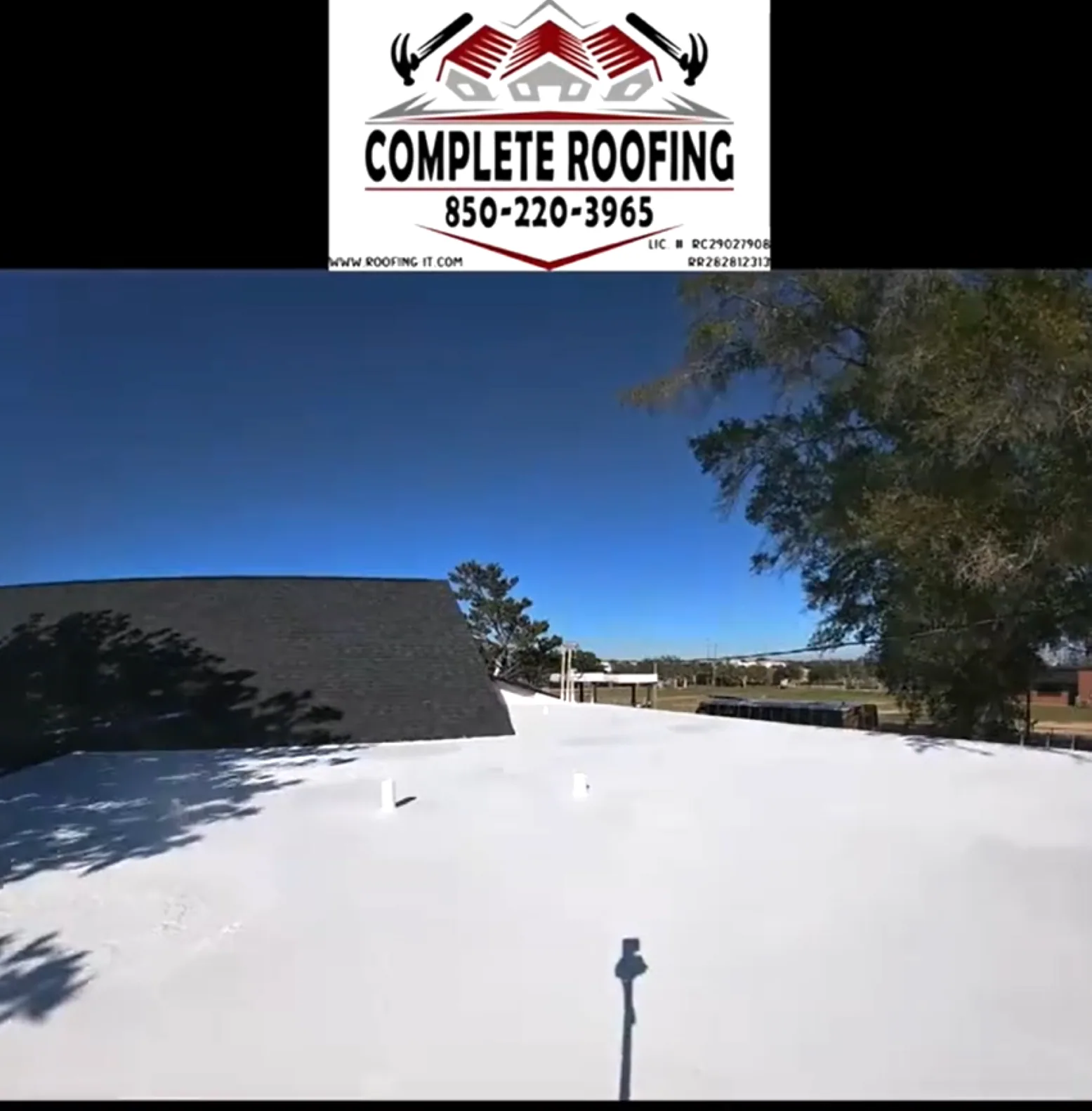
A properly installed TPO or modified bitumen flat roof lasts 20 to 30 years in our climate. Reflective coatings can extend that lifespan further and are a cost-effective way to restore an aging flat roof without a full replacement.
In many cases, yes. If the underlying membrane and insulation are still in good condition, a silicone or elastomeric coating can seal the surface, restore reflectivity, and add 10–15 years of life. We inspect the roof thoroughly before recommending a coating over replacement.
Related Services
Explore our other roofing services across the Florida Panhandle.
Commercial Roofing
From flat-roof coatings to full TPO installations, we protect commercial properties with the same over-engineered standards we bring to every residential job.
Learn moreRoof Repair & Storm Damage
Missing shingles, active leaks, wind damage — we respond fast with same-day emergency tarping and permanent repairs built to our full-roof standards.
Learn more26-Gauge Metal Roofing — Exposed Fastener & Standing Seam
Heavy-gauge 26-gauge panels in both standing seam and exposed fastener profiles — Kynar 500 on standing seam, Sherwin-Williams WeatherXL on exposed-fastener panel — with stainless fasteners spec'd for salt air.
Learn moreComplete Roof Replacement
Every replacement includes our 6-nail install, double-layer synthetic underlayment, taped deck, and GAF Timberline architectural shingles, up to Timberline UHDZ on our full GAF Lifetime Roofing System. No builder-grade shortcuts.
Learn moreFree Roof Inspection
Drone plus on-foot inspection, a written photo report, and a straight answer: fix it, watch it, or replace it. No charge, no pressure.
Learn moreStorm & Hurricane Damage Repair
Same-day emergency tarping, a thorough damage assessment, and photos and a repair scope for your adjuster. When a storm hits the Gulf Coast, Complete Roofing is the first call to make.
Learn moreSee this work on real Panhandle roofs
No stock footage — these are our own crews on real Escambia, Santa Rosa and Okaloosa County jobsites. Tap any clip to watch.
Flat Roofing Service Areas
We provide flat & low-slope roofing — sbs modified bitumen, tpo & epdm across the Florida Panhandle.
Ready to get started?
Get a satellite-measured quote in 30 seconds — or request a free on-site inspection.